Bringing in a designer usually starts when the space begins to slow things down.
Not in obvious ways, but in small, repeated moments. Meetings take longer to schedule. Storage starts spilling into work areas. Teams adjust how they work just to make the space function.
These issues rarely feel urgent on their own. But together, they point to something deeper. The office design is no longer aligned with how the business operates.
For office managers, the goal is not just to improve the space. It is to prepare the business to make the right decisions once a design process begins.
Strong office interior design depends on that preparation. Without it, even experienced interior design services end up reacting to symptoms instead of solving the underlying issues.
Office Interior Design Should Start With Workflow, Not Layout
Layout is often the first thing people think about. In reality, workflow is what determines whether a layout will succeed.
Before engaging any interior design services, it helps to look closely at how work actually moves through the office. Where teams collaborate, where interruptions happen, and where delays tend to build.
For example, a team that frequently shifts between focused work and quick discussions may struggle in a layout that forces them into either fully open or fully enclosed spaces. Over time, this creates friction that slows output.
Office interior design becomes far more effective when workflow is clearly mapped. It ensures the space supports how work happens, not just how it is organized on paper.
Commercial Interior Design Needs a Real Count of Meeting Demand
Meeting rooms are one of the most common pressure points in growing offices.
The issue is rarely the total number of rooms. It is the mix. Too many large boardrooms and not enough small, focused spaces. Or the opposite, where teams compete for rooms that can support hybrid meetings.
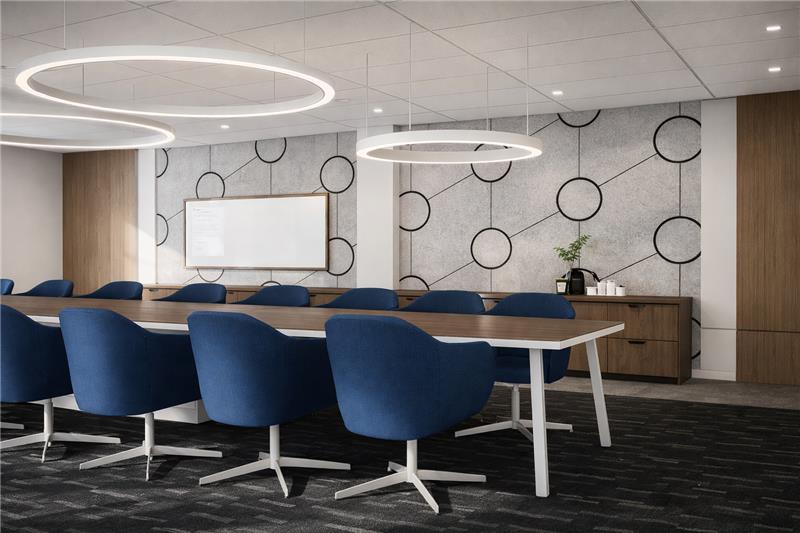
Before starting a commercial interior design project, it is important to review how meeting spaces are actually used. Which rooms are always booked. Which ones are avoided. How often meetings are delayed or moved because the right space is not available.
This insight shapes a more accurate office design layout and prevents one of the most common post-project frustrations.
Office Space Planning Should Address Storage Before It Becomes Visible
Storage problems tend to appear slowly.
At first, it’s extra materials placed near desks. Then shared storage fills up. Eventually, items start moving into circulation areas or unused corners.
By the time it becomes noticeable, it is already affecting how the office functions.
Office space planning should account for both current and future storage needs. Not just volume, but access. What needs to be close to teams. What can be centralized. What needs to remain flexible.
Ignoring storage early often leads to clutter later, and clutter quickly affects both efficiency and perception.
Office Design Layout Must Consider Acoustics Early
Noise is one of the most underestimated factors in workplace performance.
In many offices, the issue is not overall noise level but how sound travels. Conversations carry further than expected. Phone calls overlap with focused work. Meeting rooms lack enough separation for privacy.
These problems are difficult to fix after the layout is finalized.
A well-planned office design layout considers acoustics from the beginning. Placement of teams, types of partitions, and separation between quiet and active zones all play a role.
When this is overlooked, teams often compensate by changing how and where they work, which reduces overall efficiency.
Office Furniture Design Should Support Both Use and Movement
Furniture decisions influence more than comfort. They affect how easily teams can move, collaborate, and adapt the space over time.
Office furniture design should be aligned with both workflow and flexibility. Workstations need to support daily tasks without limiting movement. Meeting setups should reflect how discussions actually happen, especially in hybrid settings.
Canadian office furniture systems often provide modular options that allow reconfiguration without full replacement. This becomes especially valuable as teams grow or shift.
Addressing furniture early ensures it supports the office design layout instead of restricting it.
Corporate Interior Design Should Minimize Disruption During Implementation
A design project does not happen in isolation. It happens while the business continues to operate.
Corporate interior design should account for how the work will be implemented, not just how it will look when finished.
This includes phasing, temporary setups, and how teams will function during changes. If this is not planned early, disruption can affect productivity more than expected.
Office managers play a key role in identifying which areas are most sensitive and how operations can continue with minimal interruption.
Interior Design Services Depend on Clear Coordination
Even well-designed projects can struggle without proper coordination.
Decisions may be delayed, feedback may conflict, and timelines may shift. These issues often have less to do with design and more to do with how the process is managed.
Interior design services work best when there is a clear structure for communication and decision-making.
Interior design firms Toronto rely on this clarity to keep projects moving efficiently. Knowing who provides input, how feedback is consolidated, and when approvals happen reduces friction throughout the process.
Frequently Asked Questions (FAQ):
What should office managers review before hiring interior design services?
Focus on workflow, meeting room usage, storage needs, and areas where the space is creating delays. These factors provide a clearer picture of what the design needs to address.
Why is meeting room count often misjudged?
Many offices plan based on total headcount instead of actual meeting behaviour. The type and frequency of meetings matter more than the number of employees.
How does storage affect office performance?
Poor storage leads to clutter, and clutter reduces efficiency. It also affects how the office is perceived by both employees and visitors.
Key Takeaways
- Map workflow before thinking about layout changes
- Analyze meeting room usage to determine the right mix
- Plan storage early to prevent clutter and inefficiency
- Address acoustics at the layout stage, not after
- Choose furniture that supports flexibility and movement
- Plan implementation to reduce disruption to daily operations
- Establish clear coordination and decision-making structures
Hiring a commercial interior designer is not just a design decision.
It is an operational one.
When office interior design, commercial interior design, and office space planning are grounded in how the business actually works, the outcome becomes more predictable and more effective.
For office managers, the checklist is not about adding more steps. It is about creating clarity where it matters most.
That clarity is what turns a design project into a real improvement.
Get a workplace function review with us, starting with a clear view of how your office actually functions will make every decision that follows more effective.