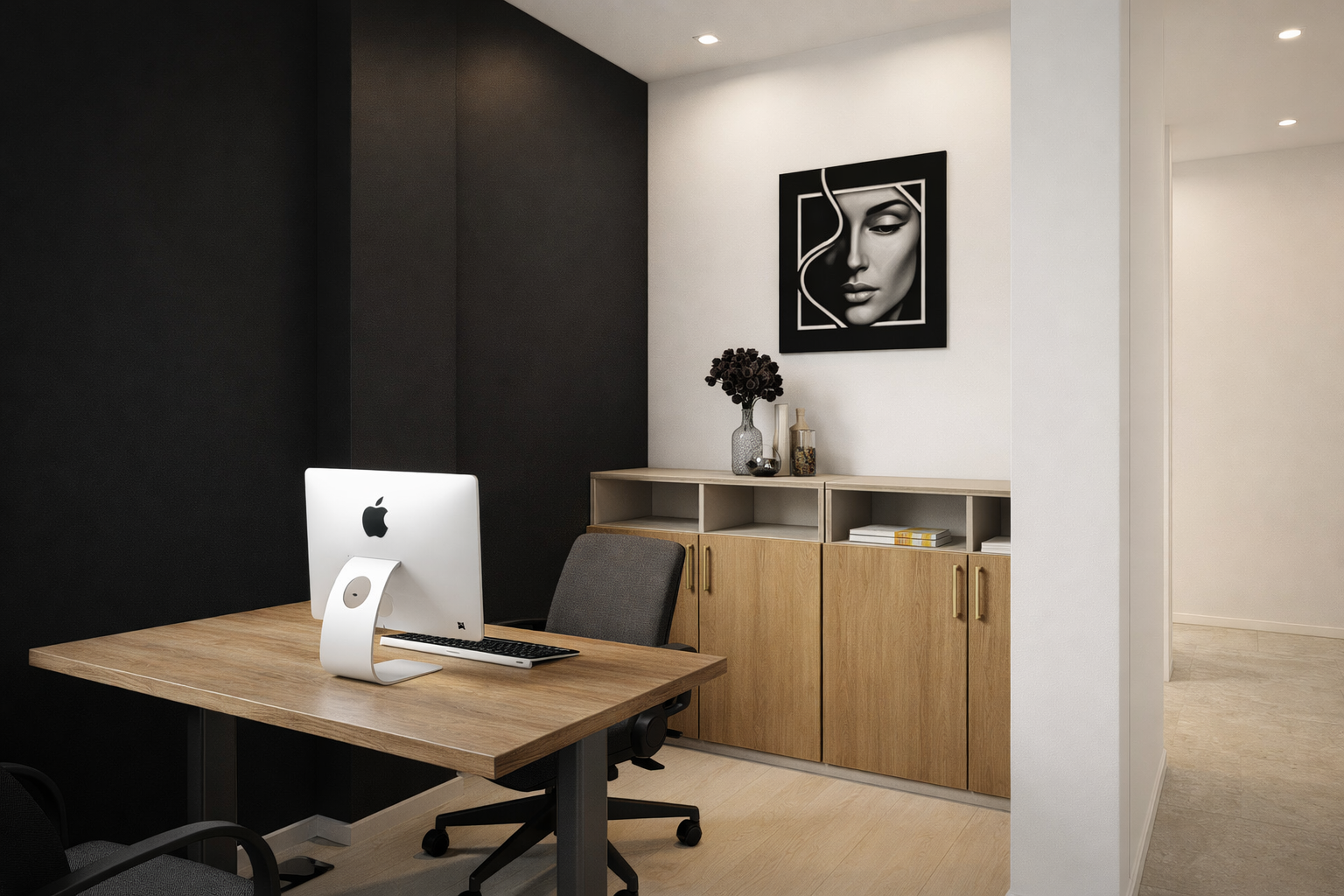
Growth is a good problem to have. New clients, new hires, new revenue. But growth tends to outpace the office faster than anyone plans for.
Most office designs in growing companies make the same mistakes when it comes to their workspace. They add desks without rethinking the layout. They ignore acoustic problems until they become complaints. They design a space for the company they were instead of the company they are becoming.
These office mistakes are common. They are also expensive. And in most cases, they are entirely avoidable with the right approach at the right time.
This post breaks down the most frequent office space mistakes growing businesses make. It also explains exactly what to do instead.
Mistake 1: Adding Desks Without Changing The Layout
Growth creates an obvious, immediate need: more seats. So companies add desks. They fill in gaps on the floor plan, squeeze another workstation into a corner, and push tables together to fit a new hire starting Monday.
This approach solves the headcount problem. However, it creates several others.
First, adding desks without redesigning the layout usually breaks the acoustic logic of the space. A quiet zone that worked for eight people does not work for twelve. A collaboration area that sat comfortably between two teams becomes a noise source in the middle of a crowded floor.
Second, the physical density communicates something to the people inside it. Cramped conditions signal that the company is operating in survival mode, not growth mode. Employees notice this before they can articulate it. New hires feel it in their first week.
According to the 2026 commercial office outlook published by Commercial Property Executive, the most competitive workplaces in 2026 are defined by intentional design and flexible zones, not raw square footage. Companies that simply pack more people into existing layouts fall behind that benchmark quickly.
The fix is straightforward. When headcount grows by 20% or more, treat it as a prompt for a layout review. Adding desks and reviewing the layout at the same time costs very little extra. Fixing a broken layout later costs significantly more.
Mistake 2: Treating Acoustics As An Afterthought
Poor acoustics is the most consistently cited workplace complaint in 2026. Research published by OP Group found that acoustic problems rank as the top issue employees raise about their office environment.
Growing companies make this mistake repeatedly. They design an open-plan office because it looks collaborative and costs less to fit out. Then they discover that an open plan without acoustic management is simply a loud room.
Noise affects more than comfort. Employees in acoustically poor environments report higher stress levels, lower concentration, and greater difficulty completing complex tasks. Over time, these daily frustrations contribute directly to disengagement and turnover.
The most effective acoustic interventions are not expensive. Ceiling-mounted baffles, soft partition panels, and designated quiet zones all reduce noise meaningfully. However, they need to be planned into the layout from the start. Retrofitting acoustic treatment into an already crowded floor plan is harder and more costly than designing for it early.
For growing companies in the GTA, this is particularly relevant. Many businesses in Newmarket and York Region expanded their teams rapidly between 2022 and 2025. A significant number of those companies are now dealing with acoustic environments that were never designed for their current headcount. A targeted acoustic review is often one of the highest-return investments a business of 25 to 60 people can make.
Mistake 3: Designing For The Org Chart, Not The Workflow
Many growing companies lay out their office based on hierarchy. The leadership team sits together. Each department has its own cluster. The layout mirrors the organisational structure on paper.
This approach feels logical. In practice, it often works against the way the business actually operates.
Modern commercial offices in 2026 are redesigned around activity-based zones, not reporting lines. Research from Bryan Construction’s 2026 commercial renovation study found that the most effective office transformations prioritise flexible zones aligned to how work flows between people, rather than how the company is structured on an org chart.
In a professional services firm, the people who need to interact most frequently are not always from the same department. A growing technology company may have product and sales teams that collaborate daily but sit on opposite ends of the floor. A healthcare organisation may have administrative and clinical support staff who share workflow but are physically separated by a design that mirrors a hierarchy they rarely work within.
The fix starts with a workflow audit before any layout decisions. Ask each team who they actually work with most, what kind of work they do, and what environment they need to do it well. Use those answers to inform zone placement, not the org chart.
Mistake 4: Underinvesting In The Client-Facing Space
Growing businesses often focus their design budget on the areas where the team spends the most time. As a result, the reception area, the boardroom, and the client meeting rooms get the lowest priority.
This is a costly inversion of logic. The spaces clients see first carry the most weight in how they perceive the company.
A reception area that looks temporary or unfinished communicates uncertainty. A boardroom with mismatched chairs and an outdated whiteboard tells a visitor the company has not invested in itself. Both impressions happen within seconds of arrival, and both are difficult to reverse.
For growing companies in Newmarket and the GTA that regularly host clients on-site, this matters significantly. The Gensler 2025 Global Workplace Survey confirmed that the quality of the physical workplace directly shapes perceptions of the organisation’s credibility and ambition. Those perceptions apply to clients and candidates equally.
Fixing this does not require a full fit-out. In many cases, a focused redesign of the reception and primary meeting room, with updated finishes, cohesive furniture, and proper lighting, is enough to shift the impression the space makes. Start with what clients see first, then work outward.
Mistake 5: Waiting Too Long To Act
This is the most common mistake of all. A growing company recognises that the space is not working. Leaders acknowledge it in conversations. A renovation gets added to the agenda for next quarter, then the one after that, then the year after.
Meanwhile, the space continues to work against the business. Recruitment suffers. Retention erodes. Return-to-office compliance stays lower than expected.
The data supports acting early. Commercial office renovation timelines in Ontario typically run three to six months from initial consultation to completion. Companies that wait until the problems become critical end up managing a disruptive renovation while already dealing with a team that is frustrated, overstretched, and in some cases actively looking elsewhere.
The more practical approach is to treat a 20% headcount increase, a lease renewal, or a significant shift in how the team works as a natural trigger for a layout review. These windows allow for planned, budget-conscious changes rather than reactive ones.
In 2026, the most competitive commercial spaces in the GTA are defined by flexibility and quality rather than size. Companies that act proactively on their office environment are consistently better positioned for talent acquisition, retention, and client confidence.
Frequently Asked Questions (FAQ):
What are the most common office space mistakes growing companies make?
The most consistent mistakes are adding desks without rethinking the layout, ignoring acoustics until they become a serious problem, designing the space around the org chart rather than actual workflows, and underinvesting in client-facing areas. The most damaging mistake of all is waiting too long to address any of these issues. Growing companies often recognise that their space is not working but delay action until the problems are significant enough to affect recruitment, retention, and team performance.
When should a growing company renovate its office space?
The clearest triggers are a headcount increase of 20% or more, a lease renewal, a significant shift in how the team works such as a new hybrid policy, or the addition of a new function that changes how the space needs to operate. These moments allow for planned, budget-conscious redesigns rather than reactive ones. Companies that wait until problems become critical typically face more disruptive and more expensive projects.
How much does an office renovation cost for a growing company in Newmarket or the GTA?
Cost depends on the scope of work. Targeted improvements, such as an acoustic retrofit, a layout reconfiguration, or a reception redesign, typically range from $15,000 to $50,000 depending on the size of the space and the level of finish. A full commercial fit-out or redesign in the GTA generally runs between $50 and $150 per square foot. The most cost-effective approach is to address changes during a natural business milestone rather than as an emergency response to a space that has already failed.
Key Takeaways
- Growing companies most commonly make five office space mistakes: adding desks without redesigning the layout, ignoring acoustics until it becomes a complaint, designing for the org chart rather than actual workflows, underinvesting in client-facing areas, and waiting too long to act.
- A 20% increase in headcount is the clearest trigger for a layout review. Treating it as a prompt for redesign rather than just a furniture purchase avoids much larger costs later.
- Poor acoustics is the top workplace complaint in 2026. It affects productivity, stress levels, and retention. Acoustic treatment is most cost-effective when planned into the layout early, not retrofitted later.
- Laying out an office based on the org chart often works against how the business actually operates. Workflow-based zone planning produces better results.
- The spaces clients see first carry the most weight in how they perceive the company. Reception areas and client meeting rooms deserve more design investment, not less.
- Commercial office renovations in Ontario typically take three to six months. Acting at a natural trigger point, such as a lease renewal or a growth milestone, is significantly less disruptive than reacting to a space that has already broken down.
- The most competitive offices in the GTA in 2026 are defined by intentional design and flexibility. Companies that invest proactively in their space consistently outperform those that do not on retention, hiring, and client confidence.
Growth creates pressure on every part of a business. The office is one of the places that pressure shows up first and gets addressed last.
The companies that get this right do not wait until the space has broken down. They treat each growth milestone as a prompt to review the environment and make deliberate decisions about what comes next.
That approach costs less, disrupts less, and delivers more than any reactive renovation ever will.